具有发送与接收证明的沟通
电子通知
在Lleida.net,您只需支付所消费的费用,我们没有订阅或订阅费用,并且购买永不过期
就像发邮件那么简单
签署文件与合同
我们的分部 国际化
Lleida
Madrid
Paris
London
Miami
Dubai
San José
Bogotá
São Paulo
Tokyo
Santo Domingo
Cape Town
Johannesburg
Montevideo
Santiago de Chile
Lima
Beirut
Ciudad de México

对于我们的服务满意的客户
成功案例
We particularly loved the ease and agility of contracting the system and its credit-based use. In other words, you top up some credits and start working without too much training, without any specific software installation or technical complexity
Registered notification service has made possible to help in the internal operating processes of companies and in their digital transformation.
Lleida.net gives us peace of mind and guarantees that parents verify the engagement of our services in a simple safely and legally way.
Connectaclick Pro允许HolaLuz为客户提供量身定制的解决方案,成为我们 必要 纳入所有流程的必备服务。
感谢本协定,允许我们为用户提供安全,可信和高效率的服务,为其提供最高质量的沟通与关注。











新闻,教程,访谈等
Blog

 6 十一月, 2026
Share your Christmas lottery shares without any nasty surprises
What if the wish came true?
After sending, the organizer will receive the Certificate of Lleida.net, a PDF document that certifies the issuer and the recipients, the message, the day and time of sending and the attachments, in this case, the photo of the décimo And although we are always well intentioned, money talks. So,to avoid surprises nothing better to leave everything well tied up through an immediate, economic and legally valid service. Good luck to all!
 4 十一月, 2026
Spanish Employment Law Update: How to Comply With Royal Decree 723/2026
Spanish employment law changed on 5 October 2026. Since that date, every employer in Spain must rethink how it informs staff about their working conditions, both when someone joins and whenever their terms change.
The change comes from Royal Decree 723/2026, the new Spanish employment law rule on transparent and predictable working conditions. It requires employers to give each worker detailed written information about their employment before their first day. That covers everything from the rules for changing shifts to the exact length of the probationary period and how variable pay is calculated.
The employer must also keep proof that the information was sent or received. Without that proof, it will struggle to show compliance during a labour inspection or an employment dispute.
This guide is for anyone who runs a business in Spain, manages HR for a multinational with Spanish staff or needs to understand Spanish employment law. It covers the main changes, what information you must provide, the deadlines and how to prove delivery.
What Is Royal Decree 723/2026? A Key Change in Spanish Employment Law
Royal Decree 723/2026 (Real Decreto 723/2026) came into force on 5 October 2026. It was published in Spain’s Official State Gazette (BOE) on 15 September. It partially transposes Directive (EU) 2019/1152 on transparent and predictable working conditions into Spanish employment law. It also replaces Royal Decree 1659/1998, which is repealed in full.
If you are familiar with the UK’s written statement of employment particulars, the idea is similar. However, the content, deadlines and procedures are set by Spanish employment law.
This is far more than a routine update. The decree’s most significant changes are:
- It expands the information each worker must receive.
- It brings the deadline forward to before the first working day. The two-month window allowed under RD 1659/1998 no longer exists.
- It adds new topics, such as equality plans and the employer’s use of algorithms to make employment decisions.
Who Must Comply? Scope Under Spain’s Workers’ Statute
The decree applies to all companies and workers covered by Spain’s Workers’ Statute (Estatuto de los Trabajadores, art. 2.1), the cornerstone of Spanish employment law. The duty to inform only affects employment relationships lasting more than four weeks (art. 2.2), so contracts of four weeks or fewer are excluded.
In practice, it affects almost any business that hires staff in Spain, regardless of size or sector. That includes foreign companies with employees under Spanish employment contracts.
Mandatory Employee Information Under Spanish Employment Law
Under Spanish employment law, employers must now inform workers in writing of at least 17 aspects of the employment relationship (art. 3.2). The employment contract can cover them if it includes all of them. Otherwise, the employer can add a separate information document (arts. 3.1 and 6.1).
Beyond the usual details (identity of the parties, job role, start date and type of contract), employers must specify:
- Pay: base salary and each supplement listed separately, payment frequency and method, how variable pay is calculated, and the criteria for earning it.
- Working time: length and distribution of the working day, shifts, and the circumstances and procedures for changing them. Also overtime and how it is paid, holidays and how they are scheduled, and, where applicable, irregular distribution of working hours with the related notice periods.
- Probation, training and termination: the probationary period, training, and how the contract can be terminated.
- Collective agreement and benefits: the applicable collective agreement (code, publication date and term), the entity collaborating with the Social Security system, voluntary benefit improvements, and pension plans.
- Changes to the job: the circumstances and procedures under which duties, job category, pay or working hours could change.
For several of these points, a precise reference to the law or the applicable collective agreement is sufficient (art. 3.3). Spain’s Public Employment Service (SEPE) has published an official template information document, although its use is not mandatory.
Algorithms, Equality and Harassment: New Topics in Employment Law in Spain
One of the most striking changes to Spanish employment law is the explicit reference to algorithmic or automated decision-making systems. If the employer uses them, it must tell workers in writing that they exist. If the systems are used to determine working conditions, the employer must also explain the parameters, criteria, and rules underlying them (art. 3.2.k). Examples include how working hours are distributed or how careers progress.
The employer must also identify the applicable equality plan and its protocol against sexual and gender-based harassment. Where they exist, it must also report:
- Its work–life balance policy, if it improves on the legal minimum.
- Its measures and resources for the equality of LGBTI people.
What Happens With Existing Employees Under Spanish Employment Law?
Anyone joining from 5 October 2026 onwards must receive all this information in writing before their employment begins, without having to ask for it.
Existing staff do not receive it automatically, but they can request any information they lack. That includes changes made before 5 October. If they ask, the employer has 30 working days from receiving the request to provide it (sole transitional provision). In Spain, working days (días hábiles) generally exclude Saturdays, Sundays and public holidays, so the deadline is longer than 30 calendar days.
Under Spanish employment law, later changes must be communicated without anyone having to ask, including to existing staff. If the employer modifies any condition it must report on, such as pay, working hours or shifts, it must say so in writing as soon as possible. The deadline is the day on which the change takes effect, at the latest (arts. 5 and 7.3). There is one exception: if the contract only referred to a law or collective agreement and that rule is the one that changes, no notice is needed (art. 5.2).
How to Prove the Worker Received the Information
Under Article 6.2, the information can be provided on paper or electronically. In either case, the worker must be able to access, store and print it. The employer must also keep proof of transmission or receipt.
Spanish employment law does not specify what proof is valid or how long it must be kept. Each employer has to decide, and that choice can make all the difference in an inspection or an employment dispute. If you cannot show what information you provided and when, you will find it harder to defend, for example, the agreed probationary period or notice periods.
That is why it makes sense to choose a method that can prove four things:
- What exact document was delivered. If the information is split between the contract and an annex, this applies to both.
- Who received it.
- When it was delivered.
- That nobody has altered it since.
Here is how the most common delivery methods compare under Spanish employment law:
| Method | Meets format requirements (art. 6.2)? | Proof of transmission or receipt | Limitations |
| Paper signed by the worker | Yes | Handwritten signature and date | Hard to manage at scale and for remote onboarding |
| Standard email | Yes, if the document can be downloaded and printed | Limited: shows it was sent, but does not guarantee receipt or that the content was not altered | Easy to challenge |
| Employee portal or intranet | This depends on whether it allows downloading and printing | Internal access logs | It may not be active before day one, and the worker may lose access after leaving. Temporary links do not guarantee retention |
| Electronic signature of the document | Yes | The worker’s signature, date and time on the exact document | Requires a signature tool |
| Registered electronic communication via a third party | Yes | Independent evidence of the content, sending, delivery, date and time | Requires a provider |

Non-Compliance: Fines and Risks Under Spanish Employment Law
Suppose the employer fails to provide the information on time, or does not answer an existing employee’s request within 30 working days. The worker can then report it to the Labour and Social Security Inspectorate (Inspección de Trabajo) or file a claim with the employment courts (juzgado de lo social).
Are you an employee in Spain? Keep proof of your request. A Lleida.net registered email proves what you sent and the exact date and time it was delivered.
For the employer, the fine is not the only risk. Failing to provide written information on the terms and within the deadlines set by the decree is a minor offence under art. 6.4 of Spain’s Law on Social Order Infringements and Sanctions (LISOS). It carries fines of €70 to €750. But the costliest consequence is often being unable to prove what information was given and when. That is why it pays to log every request and respond with proof of delivery.
How to Comply Using eSignatures and Registered Communications
The most practical way to meet this Spanish employment law requirement (art. 6) is to combine two elements in one electronic channel:
- It delivers the document in an accessible format that the worker can save and print.
- It generates proof of transmission or receipt simultaneously.
Lleida.net is a trust service provider under Regulation (EU) No 910/2014 (eIDAS) and Spanish Law 6/2020. Its solutions let you send the information, collect signatures and keep proof of delivery:
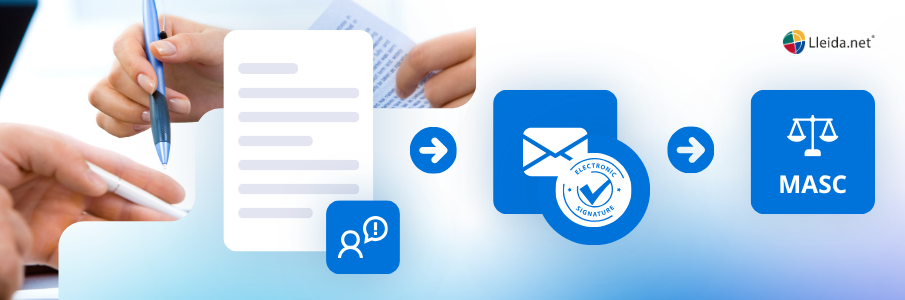
- Click & Sign: simple, advanced or qualified electronic signatures with full legal validity for employment contracts. You send the contract and the information document through registered channels such as SMS, RCS, email or WhatsApp. The worker’s signature arrives instantly and serves as acknowledgement of receipt.
- Registered email: sends the document with evidence of its content and the date and time of delivery to the recipient’s server.
- Registered SMS: a notification with a link to download the document, plus evidence of delivery.
- Registered RCS and WhatsApp: send the document, or a download link, with evidence of delivery and of access to the content.
Checklist: Adapting Your Business to the New Spanish Employment Law Rules
Royal Decree 723/2026 is already in force, so the first step to comply with Spanish employment law is to review how you currently inform your workforce:
- Review your contract templates. Check whether they cover every item in art. 3.2. If not, add an information document, either the SEPE template or your own.
- Identify the new topics that apply to you: algorithmic systems affecting employment decisions, equality plan, harassment protocol, work–life balance policy and LGBTI measures.
- Set up a channel for communicating changes to working conditions. It must also allow you to deliver the information in a way you can substantiate.
- Prepare a procedure for requests from existing staff. Respond within 30 working days and keep the proof.
- Adapt the information for employees with disabilities or limited intellectual capacity: Employers must ensure that the information is provided in a format that is accessible, clear and easy for them to understand (Art. 6.3).
The goal is twofold. Each worker should receive clearer, more complete information about their working conditions in Spain, and you should have proof to present during an inspection or a dispute. If you have not yet adapted your processes, digital, traceable tools can turn a legal obligation under Spanish employment law into a means of preventing future disputes.
FAQ: Spanish Employment Law and Royal Decree 723/2026
What is the main source of employment law in Spain?
The Workers’ Statute (Estatuto de los Trabajadores) is the core of Spanish employment law. It is complemented by sector collective agreements and by regulations such as Royal Decree 723/2026.
Does Royal Decree 723/2026 apply to foreign companies?
It applies to employment relationships within the scope of the Workers’ Statute. If you employ staff in Spain under Spanish employment law, the obligations apply wherever your company is headquartered.
When must the information be provided?
Under Spanish employment law, new hires must receive it in writing before their first working day. Changes to working conditions must be communicated by the day they take effect.
Do notice periods have to be included in the written information?
Yes. Termination of the contract is among the topics employers must inform about in writing. For several points, a precise reference to the law or the applicable collective agreement is enough.
What is the fine for non-compliance?
Under Spanish employment law, failing to provide the information correctly is a minor offence (LISOS), punishable by a fine of €70 to €750. The bigger risk is being unable to prove what was delivered and when.
 2 十月, 2026
Spanish Mortgage Claim: How to Prove You Sent Your Prior Claim to the Bank
If you bought a property with a mortgage in Spain, there is a new rule you need to know before taking your bank to court. To move forward with a Spanish mortgage claim, you must be able to prove that you first sent a written claim to the bank. That proof has to show three things: what you sent (the text and any attachments), when you sent it (date and time) and what reached the recipient.
For a Spanish mortgage claim,a standard email or a web form does not guarantee this. A Registered email or a burofax does. And this is no minor detail: since Organic Law 1/2025 (Ley Orgánica 1/2025) came into force, if you sue over an unfair clause in your mortgage without proving that prior claim, the court may refuse to admit your case.
Why this matters if you bought a property in Spain from abroad
Thousands of British and other European buyers have taken out mortgages in Spain to buy a holiday home, a retirement property, or a home for a future move. Spanish consumer protection law applies to them in the same way as it does to Spanish residents: if you signed the loan as a private individual, not for business purposes, you are treated as a consumer.
That means you can benefit from the Spanish Supreme Court’s rulings on unfair mortgage clauses. It also means you are bound by the same procedural rules, including the obligation to claim from the bank first. The good news is that you do not need to travel to Spain to do it: a Spanish mortgage claim can be sent by email from anywhere.
A recent example: single-premium life insurance
On 11 June 2026, the Spanish Supreme Court (Judgment No. 913/2026 – ECLI:ES:TS:2026:2627) ruled that it is unfair for a bank to require a customer to take out single-premium life insurance, financed through the mortgage itself and arranged with an insurer from the bank’s own group, without letting the customer choose another insurer or pay periodic premiums. According to the Supreme Court, the cost of that premium should also have been included in the APR (known in Spain as the TAE).
In the case decided, the premium was almost €24,500 on a mortgage of around €151,500: more than 16% of the capital. If you took out a mortgage in Spain on similar terms, you may be able to recover the unused part of the premium and the interest you have paid to finance it.
But before thinking about court, the law requires you to take a first step: send a Spanish mortgage claim to the bank in writing, and be able to prove it.
Is a prior Spanish mortgage claim compulsory before going to court?
Claiming from the bank before going to court is nothing new. Spanish banks have had customer service departments for more than twenty years. In 2017, an out-of-court procedure was also created for floor clauses, but it was voluntary: you did not need to use it to sue.
What changes with Organic Law 1/2025 on the efficiency of the Public Justice Service is that the claim is no longer optional. Since 3 April 2025, Article 439.5 of the Spanish Civil Procedure Act (Ley de Enjuiciamiento Civil, or LEC) states that lawsuits to recover amounts paid under unfair clauses in mortgage loans will not be admitted unless they include a document proving the prior claim to the bank.
In other words: if you cannot prove your Spanish mortgage claim, your case may never get past the front door.
How the out-of-court Spanish mortgage claim procedure works (Article 439 bis LEC)
For consumer claims against financial institutions over unfair clauses, Article 439 bis LEC sets out a specific procedure:
- How it starts: you send your Spanish mortgage claim to the financial institution that granted your loan.
- The bank’s response: the bank must either accept or reject it.
- If it accepts, it must provide you with a breakdown of the amount to be refunded, including interest. If you accept, the bank must also acknowledge that the clause is null and void.
- If it rejects, it must give reasons for its decision.
- Your decision: you must accept or reject the bank’s proposal.
- Deadlines: see the table below.
- End without agreement: the procedure ends if the bank expressly rejects the claim, if a month passes without a reply, or if you disagree with the calculation, the amount offered or the bank’s position on the nullity of the clause.
| Stage | Deadline |
| Agreement between the consumer and the bank | 1 month from submission of the claim |
| Payment after accepting the offer | 1 further month from the consumer’s acceptance of the offer. If the bank does not pay, the late-payment interest rate rises by 8 percentage points, and you can go to court |
The procedure is free of charge, and while it is underway, neither party can take legal action on the same matter. There is one more key point: the positions you and the bank take during this stage may later be considered by the court when deciding who pays the legal costs. That is why being able to prove exactly what your Spanish mortgage claim said, and on what grounds, matters so much.
What evidence proves your Spanish mortgage claim?
This is where many a Spanish mortgage claim falls down. Not every communication channel leaves the same record:
| Channel | Proves content | Proves date and time | Proves delivery |
| Standard email | Partially | Partially | No |
| Ordinary letter | No | No | No |
| Burofax with text certification | Yes | Yes | Yes |
| Lleida.net Registered email | Yes, including attachments | Yes | Yes, to the recipient’s mail server |
Why send your Spanish mortgage claim by Registered email?
The prior claim is addressed to the bank’s customer service department (Servicio de Atención al Cliente, or SAC), and most banks have a dedicated email address for it. You do not need to visit a branch or send a paper burofax, which is especially useful if you are not based in Spain.
Lleida.net Registered email generates an evidence certificate that proves the sending, the exact content, the attachments, the date and time, and delivery to the recipient’s mail server. That way, you can show what you claimed, when and on what grounds, without relying on the bank to confirm it.
Lleida.net is a trust service provider under the European eIDAS Regulation (EU) No 910/2014. Under this regulation, evidence cannot be denied legal effect in court solely because it is in electronic form.
Timing matters too. In single-premium insurance cases, the Supreme Court calculates the part of the premium already used up until the judgment becomes final. The sooner you claim, the sooner the procedure starts running.
How to send your Spanish mortgage claim with Lleida.net: 4 steps
- Write your Spanish mortgage claim in your usual email client. Identify the loan (number and date of the mortgage deed, or escritura), explain which clause you are claiming and what you are asking for. Tip: Spanish banks generally handle claims in Spanish, so writing in Spanish or attaching a translation can help avoid delays.
- Address it to your bank’s SAC email and attach the documents: your ID (passport, NIE or DNI), the mortgage deed, the FEIN (European Standardised Information Sheet) or binding offer and, if you are claiming over insurance, the policy.
- Add Lleida.net’s certifying address in the copy (CC). Before sending, check that your email address is on the whitelist in your Lleida.net account. You can follow a step-by-step tutorial for sending a Registered email here.
- Keep the evidence certificate you receive. It is your proof that your Spanish mortgage claim was sent, and of its content, and the document you will attach to your lawsuit if you go to court.
What if the bank replies to or rejects your Spanish mortgage claim?
If the bank accepts your Spanish mortgage claim, you will receive its proposed calculation and can choose whether to accept it. If it rejects the claim or fails to reply within one month, the out-of-court attempt is complete and documented. From there, you can file a complaint with the Bank of Spain (Banco de España) or consider legal action. In every case, your certificate proves that you claimed it and when.
Frequently asked questions about Spanish mortgage claims
Does the bank’s web form count as proof?
Do Spanish courts accept certified email as proof of a prior Spanish mortgage claim?
Which address should I send the claim to?
What do I do with the certificate if I end up suing?
What if the bank says the certificate is not valid?
This article is for general guidance only and isn't legal advice. Every mortgage is different, so it's worth speaking to a qualified lawyer before you make a claim.